

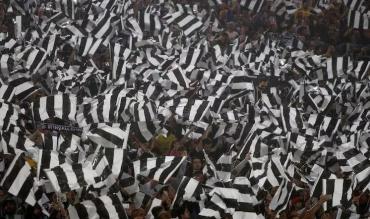

One of the world’s great sporting institutions, Juventus have won their domestic league on 36 occasions, claiming 11 major European honours for good measure.
Unquestionably, this is a club defined by its success and dominance and unquestionably too this has been achieved with a defensive mindset that has endured through the generations.
They’ve needed some sublime striker too of course, to fire them to their glories. These ten are the very best of them.
Pietro Anastasi
When Wayne Rooney exploded onto the Premier League scene one writer wasted little time in labelling him the ‘White Pele’. Anastasi boasted the same nickname almost 40 years prior.
Admired beyond Turin for his propensity to score acrobatic, spectacular goals, the Sicilian hit-man was beloved by a large tract of Juventus support who had headed north to find work in the city’s sprawling Fiat factory.
The player undertook the same journey as a teen, first joining Varese before the Zebras swooped.
A tally of 78 goals from 205 outings is a fine return for a forward who has retrospectively been credited with inventing the ‘false 9’ role.
Cristiano Ronaldo
The last time CR7 was ninth in anything was presumably back in his schooldays. Perhaps a spelling bee. As soon as his professional career took flight it’s been first or nothing for the intensely driven megastar.
And maybe an argument could be raised that one of the greatest talents in the game’s long history should be much higher on this list.
After all, he did break all manner of records at ‘Lo Stadium’ after joining the Italian giants from Real Madrid for the substantial sum €100m. That was a record in itself, the most spent on a footballer the wrong side of 30.
At Juve, Ronaldo became the first player to reach 100 Champions League appearances. He became the first player to bag 20+ goals across 12 consecutive seasons in Europe’s big five leagues. He became the first player to win every major domestic trophy in England, Spain and Italy.
All impressive feats, but here’s the rub. So many of them were completed in Serie A but were mainly achieved elsewhere.
Think of Cristiano Ronaldo and the iconic red of Manchester United or the white of Los Blancos comes to mind.
Roberto Baggio
For most of Baggio’s five years in Turin it was AC Milan who were the perennial favourites in the football betting.
Simply put, Juve had a good team, but I Rossoneri were a great team.
That largely explains why the forward’s trophy haul was scant across the Divine Ponytail’s peak years but that’s no reflection on him. For four of those five seasons he resided on another planet to almost all of his contemporaries, slaloming through defences as if on a playground, playing for kicks.
His 78 goals in 141 games is an outstanding return but it must be said that for all of his genius – and Baggio was undoubtedly a genius – his relationship with the Juventus ultras was complicated.
Many believed his heart remained in Florence after his tumultuous move in 1990 that led to Fiorentina fans rioting in the streets.
Filippo Inzaghi
At face value, Sir Alex Ferguson’s famous remark that Inzaghi was ‘born offside’ is a slight. On closer inspection however it is a compliment of the highest order.
That’s because teams were terrified of ‘Pippo’, a forward who constantly stress-tested a defence’s structure, playing on the shoulder of the last man, and probing for any momentary lapse in concentration.
Moreso, he had the finishing chops to punish them if a full-back didn’t push up at the same time as his centre-back. When through on goal, he had very few peers. Typically he would score.
He did so twice in the 2007 Champions League final for AC Milan while for Juve he notched 57 times all told, firing them to a Scudetto in 1998.
Omar Sivori
Only four players have converted more often for I Bianconeri but his hefty 135-goal compendium doesn’t wholly explain why the Argentine’s legendary status at the club is forever secure.
On joining the Italian giant in 1957 from River Plate, ‘El Grafico’ immediately struck up a fearsome understanding with fellow new signing John Charles and the incomparable Boniperti and together they ran riot, a collective force of nature that no defence could withstand.
Known as the ‘Magical Trio’ the threesome heralded a new era of dominance after some barren years for the Zebras.
Three Serie A titles followed with Sivori winning the Capocannoniere in 1960. A year later this phenomenal talent claimed a Ballon d’Or.
David Trezeguet
The French forward shared similar attributes to his fellow countryman Thierry Henry, namely an ability to drive forward, fast and direct in possession, coming in off the flank in devastating fashion.
On his day he was unplayable, and there were many days such as these, Trezeguet bagging 171 times in 320 outings for the Zebras.
When looking back on his career as a whole his international achievements stand proudest, the striker playing an integral part in France’s World Cup success in 1998.
As for his club output, for some strange reason, his decade of brilliance in Turin has been somewhat downplayed, certainly in relation to other modern greats.
Roberto Bettega
As is commonplace in Italian football, when Bettega first established himself as a player of note he was duly bestowed a nickname. In his case it was as no-nonsense as his finishing. He was simply ‘Bobby Gol’.
Naturally, there was far more to his game than purely putting away chances, though 179 strikes for the Zebras is a remarkable tally.
Bettega was a beast in the air while his tactical acumen meant he was deployed all across the attacking third and even deeper in midfield.
Throughout the Seventies, and right to the end of Giavanni Trapattoni’s managerial reign in the early-Eighties, Juventus were consistently short-priced in the sports betting, winning seven Scudettos and reaching two European Cup finals.
Bettega was top scorer for his team in six of those seasons, a fundamental part of its sustained success.
John Charles
The ‘Gentle Giant’ is revered still in Turin, sixty years after returning to Leeds United, the club that sold him for £65,000, a British transfer record at the time.
To give some indication of just how highly the forward is revered, when Juventus celebrated their centenary in 1997 a poll was conducted, to celebrate their greatest ever foreign import. Charles won the vote by a landslide.
Not Platini. Not their recent big purchase Zinedine Zidane. Not Boniek or the much-venerated Sivori.
It was the player from the Valleys, loved as much for his gentlemanly conduct on the field of play as for the manner in which he grabbed games by the scruff of the neck and bossed them.
Charles was a giant in every sense.
Alessandro Del Piero
Mothers are rarely wrong but the matriarch of the Del Piero family certainly made a misjudgement when the youngest of her two sons began a lifetime’s obsession with football.
Worried that her precious child would injure himself she instructed a youth team coach to play Alessandro in goal.
Thankfully, it quickly came to light that the skinny quiet kid with the big smile could play a bit, his talent leading to superstardom and an honours roll so comprehensive you require a nap after reading it.
Across 19 seasons for I Bianconeri, the feted forward scored 290 goals, a figure that remains unsurpassed and may well remain so forever. There is also the not-inconsequential matter of orchestrating six league crowns for Juve and a World Cup triumph in 2006 for the Azzurri.
Giampeiro Boniperti
In 465 appearances for the Zebras, Boniperti averaged nearly a goal every other game as he fired them to five league titles. For the national side meanwhile his vision, touch and ruthless finishing skills took the Azzurri to two World Cup finals, in 1950 and 1954.
So lofty is his stature on the Peninsula that he was one of the first inductees in Italy’s Hall of Fame and that honour incidentally wasn’t solely for his footballing prowess. Boniperti became a major operator behind the scenes at Juventus post-retirement, rising to the position of chairman.
“Winning is not important, it’s the only concern,” is a quote famously attributed to a man who joined Juve aged 16 and kept the club’s cause close to his heart until the day he died, aged 92.
